
Which ATEX and IECEx Certifications Are Required for Onshore Oil and Gas Load Cells? 📰
30th Jun 2026Why ATEX/IECEx Load Cells Differ From Their Offshore Counterparts
Hazardous-area certification requirements for onshore and offshore installations are broadly similar but there are some differences.
Both environments rely on ATEX and IECEx principles – and both commonly require appropriately certified equipment. The primary differences arise from environmental rather than explosive atmosphere considerations.
Offshore installations are exposed to continuous salt spray, elevated humidity, severe corrosion mechanisms and more demanding loading from vessel motion and wave action. Consequently, offshore load cells often require enhanced corrosion protection, higher-grade materials and more stringent environmental testing.
Onshore facilities generally experience less aggressive environmental conditions but may introduce challenges associated with temperature extremes (notably in deserts or continental plains), dust ingress, sand contamination and chemical exposure. Large geographic infrastructure networks can also create challenges with regard to signal degradation, long-range data transmission and reliability of power supply.
As a result, while certification markings may be identical, the detailed mechanical and environmental specification of the load cell can differ substantially between onshore and offshore projects.
Understanding ATEX and IECEx Certification
ATEX is the European regulatory framework governing equipment intended for use in potentially explosive atmospheres. The term ATEX originates from the French Atmosphères Explosibles and encompasses both equipment design requirements and installation obligations.
IECEx is the International Electrotechnical Commission’s global certification scheme for equipment used in explosive atmospheres. While technically similar to ATEX in many respects, IECEx provides internationally recognised certification that is widely accepted throughout the oil and gas industry outside Europe.
For load cells used within hazardous areas, ATEX certification is typically required for installations within the United Kingdom and European markets, while IECEx certification is frequently specified for international projects. Many operators prefer dual-certified equipment that satisfies both schemes simultaneously.
Hazardous Area Classification and Load Cell Selection
The required certification depends primarily upon the hazardous area classification of the installation:
- Zone 0 represents an area where an explosive gas atmosphere is present continuously or for long periods.
- Zone 1 applies where explosive atmospheres are likely to occur during normal operation.
- Zone 2 covers areas where explosive atmospheres are not likely to occur during normal work but may do so infrequently and for short durations.
Dust hazards are classified separately as Zones 20, 21 and 22.
Most onshore oil and gas load monitoring is found within Zone 1 and Zone 2 gas environments, although Zone 0 installations can occur in specialised processes or locations such as vessel interiors, vapour spaces, mud-gas separators, waste sumps and flare header networks.
The hazardous area classification determines the minimum equipment category or Equipment Protection Level (EPL) required. For example, equipment installed within a Zone 1 area typically requires ATEX Category 2G certification and an EPL of Gb, whereas Zone 2 generally requires Category 3G and EPL Gc.
Selecting a load cell without matching the hazardous area classification can render an installation non-compliant – regardless of the load cell’s mechanical performance.
Gas Groups and Temperature Classes
Not all hazardous atmospheres present the same ignition risk. Gas groups classify substances according to their ignition characteristics:
- Group IIA includes gases such as propane
- Group IIB includes ethylene
- Group IIC covers the most easily ignitable gases, including hydrogen.
Most oil and gas operators specify IIC-certified equipment wherever practical because it provides the broadest application range.
Temperature classification is equally important. Equipment surface temperatures must remain below the ignition temperature of the surrounding atmosphere.
Common classifications include T6 (85°C), T5 (100°C) and T4 (135°C). T4 is frequently encountered within oil and gas facilities, although specific process conditions may require lower temperature classes.
Certification Markings Engineers Should Understand
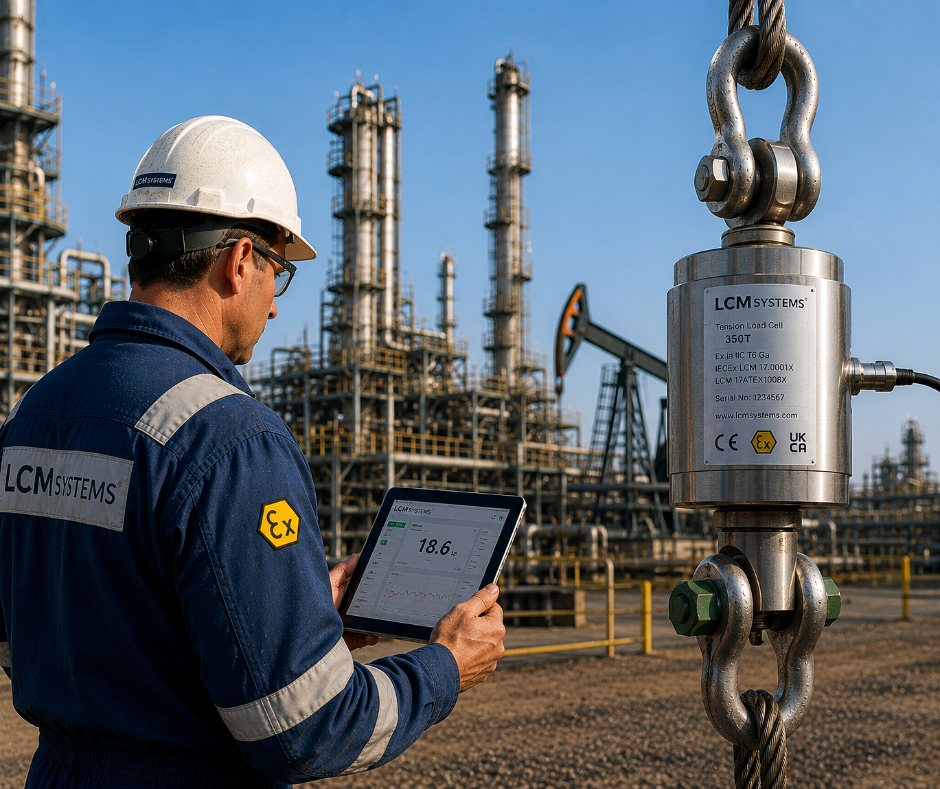
Hazardous-area load cells are marked with certification information defining where and how they may be used. A typical marking may appear as: II 2G Ex ia IIC T4 Gb
Each element has a specific meaning:
- Group II identifies equipment for surface industries (such as oil refineries, chemical plants and pharmaceutical factories) rather than mining, which has the highest certification level requirements.
- Category 2G indicates suitability for Zone 1 gas atmospheres.
- Ex confirms explosion protection compliance.
- ia identifies intrinsic safety protection – electrical and thermal energy levels are too low to ignite flammable gases, vapours or dust.
- IIC indicates suitability for the most demanding gas group, including hydrogen and acetylene.
- T4 specifies a maximum surface temperature of 135°C.
- Gb identifies the corresponding Equipment Protection Level.
Engineers should verify that all elements of the marking align with the hazardous area classification, gas composition and ambient operating conditions of the installation.
Why Intrinsic Safety Is Commonly Used for Load Cells
Many hazardous-area load cells use intrinsic safety protection concepts.
Intrinsic safety limits the electrical energy available within the circuit to levels below those capable of igniting a hazardous atmosphere. This approach is particularly well suited to strain gauge load cells because the electrical power requirements are relatively low.
An intrinsically safe load cell system typically comprises the sensing element, associated cabling, safety barriers or galvanic isolators, and any signal conditioning or telemetry equipment.
A certified load cell alone does not guarantee compliance if associated instrumentation or barriers are incorrectly specified. For this reason, engineers should evaluate the complete measurement chain rather than individual components in isolation.
Special Design Considerations for Hazardous-Area Load Cells
ATEX and IECEx load cells incorporate numerous design features beyond those found in standard industrial products.
Cable systems require particular attention because damaged insulation, inadequate screening or inappropriate glands can compromise hazardous-area integrity. Specialised armoured and chemically resistant cable constructions are often employed within oil and gas environments.
Materials selection must account for corrosive process conditions, ultraviolet exposure, hydrocarbon contamination and long-term environmental degradation. Stainless steel construction is typically preferred, with 17-4 PH and 316 stainless steel being common choices depending upon the mechanical and environmental requirements.
Signal conditioning equipment must also be certified for the intended hazardous area. This includes transmitters, junction boxes, wireless telemetry systems and local displays.
Wireless systems introduce additional certification considerations relating to battery energy storage, radio frequency emissions and enclosure protection methods. Only appropriately certified systems should be considered for hazardous-area deployment.
Typical Onshore Oil and Gas Applications Requiring ATEX and IECEx Load Cells
Hazardous-area load monitoring is widely used throughout the onshore oil and gas sector.
Drilling frequently employs load pins and load cells for hook load monitoring, pipe handling systems and tension measurement. Wirelines and slicklines commonly require certified load measurement to monitor line tension and prevent overloading.
Load shackles and load pins are routinely installed within lifting systems in classified process areas. Tank farms and storage terminals may use certified load cells for vessel weighing and inventory management.
Pipeline infrastructure often incorporates load monitoring equipment within pig launching systems, maintenance lifting arrangements and specialised tensioning.
Process plants may also employ ATEX and IECEx-certified load cells within batching, blending and weighing systems where flammable hydrocarbons or combustible dusts are present.
In each case, the certification requirement is driven not by the lifting or weighing function itself but by the hazardous atmosphere surrounding the equipment.
Dual ATEX and IECEx Certification
For many operators, dual ATEX and IECEx certification has become the preferred specification.
Dual-certified load cells simplify project approvals, facilitate international deployment and reduce the risk of compliance issues during project execution. They also provide greater flexibility when equipment may be relocated between facilities working under different regulatory frameworks.
For multinational oil and gas organisations, standardising on dual-certified load cells, load pins and load shackles can significantly reduce engineering complexity while maintaining a consistent safety philosophy across global assets.
LCM Systems for ATEX and IECEx Load Cells, Pins and Shackles
When specifying load monitoring equipment for hazardous-area oil and gas operations, certification is only one part of the engineering challenge. Reliability, measurement accuracy, mechanical integrity and long-term support are equally critical. This is where working with an experienced specialist manufacturer can make a significant difference.
LCM Systems has 40+ years of experience designing and manufacturing high-performance load cells, load pins and load shackles for safety-critical applications across the global oil and gas industry.
Unlike suppliers that simply adapt standard industrial products, LCM Systems engineers and manufactures bespoke load monitoring solutions specifically for demanding environments where hazardous-area compliance, mechanical robustness and measurement accuracy are paramount.
A key advantage is our ability to provide ATEX- and IECEx-certified load monitoring solutions tailored to your exact requirements. Whether you need a load pin integrated into a drilling system, a load shackle for lifting within a Zone 1 process area, or a specialised load cell for tension monitoring on pipeline or wireline equipment, each solution can be designed around the project’s environmental, mechanical and certification requirements.
Our in-house design and manufacturing capabilities allow complete control over product quality and performance. Engineers work directly with customers to understand the environment, hazardous area classification, loading conditions and installation constraints before developing the most appropriate solution. This consultative approach helps to ensure that the final product not only meets ATEX and IECEx requirements but also delivers reliable long-term performance in the field.
LCM Systems’ products are used throughout the oil and gas sector for lifting and handling, drilling systems, wireline equipment, riser tension monitoring, process weighing, mooring systems and other specialist load monitoring projects. Many installations are in environments where equipment failure is not an option – making proven reliability and technical support essential specification criteria.
In addition to hazardous-area certified hardware, LCM Systems can supply complete load monitoring systems incorporating intrinsically safe instrumentation, wireless telemetry, displays, data acquisition equipment and signal conditioning solutions. This enables customers to source a fully integrated measurement system from a single specialist supplier – simplifying specification, installation and ongoing support.
Contact Our Expert Team
Contact LCM Systems today and discover how our ATEX- and IECEx-certified load monitoring solutions can help to improve safety, reliability and performance.